Case Studies
sub0 hack: Impact Report
sub0 hack 2025 demonstrated continued refinement of the milestone-based hackathon model pioneered at Blockspace Synergy, while introducing key innovations around submission categorization and judging processes.
SHARE
PUBLISHED
Author
Sacha Lansky
About the Event
sub0 hack was a three-day hackathon designed to drive long-term builder retention in the Polkadot ecosystem. Organized by WebZero in collaboration with NERDCONF, the event was held alongside the sub0 conference in Buenos Aires (November 14-16, 2025), featuring dual main tracks (Polkadot and Arkiv) alongside partner bounties from Hyperbridge, XX Network, Kusama, and a Marketing track.
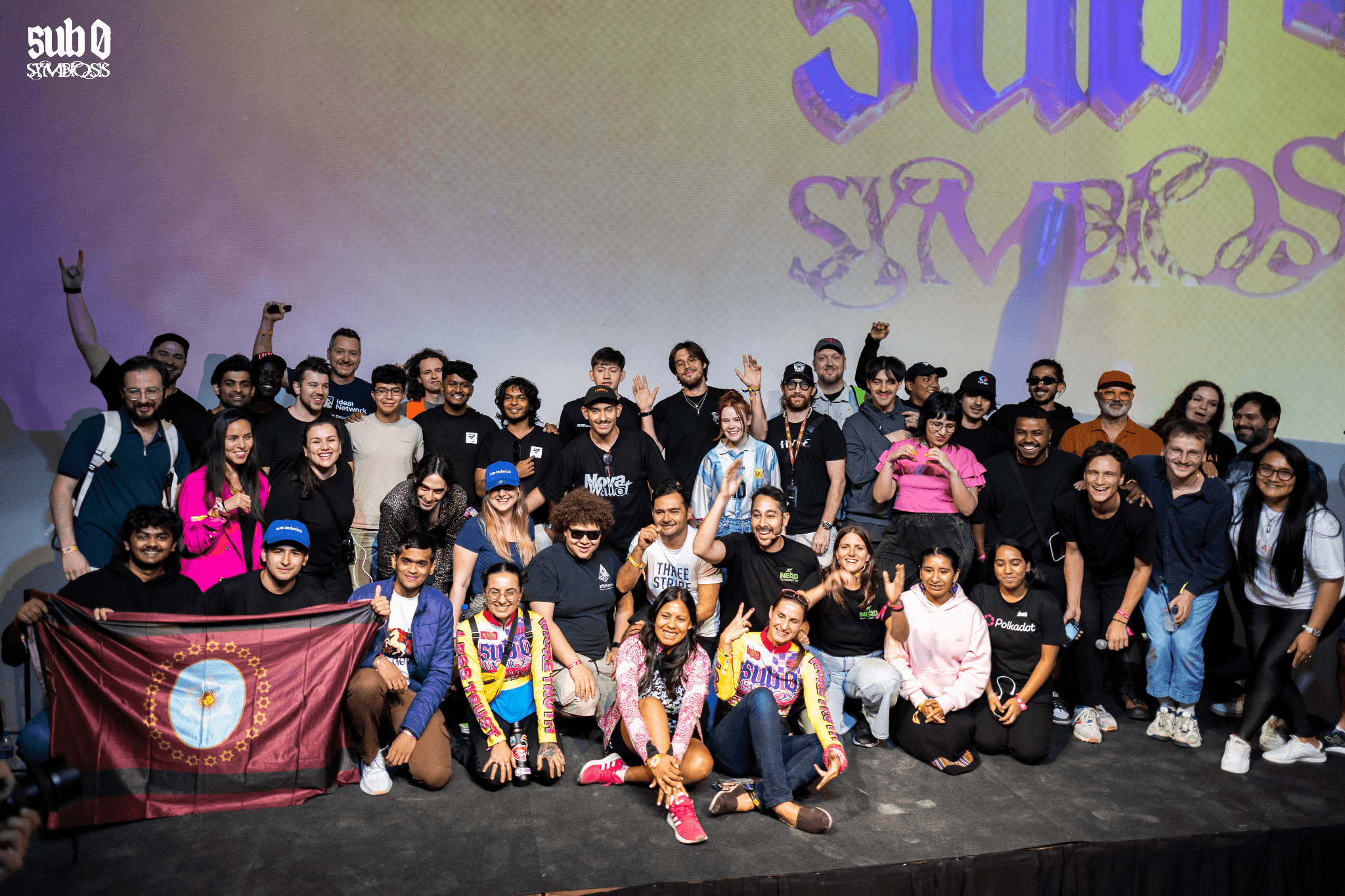
The hackathon welcomed builders from across Web3 to create cross-chain applications, data layer solutions, privacy tools, and developer infrastructure. With a focus on sustainable project development, sub0 hack introduced innovations including a Ship-a-ton vs Idea-ton submission structure and a 6-week Milestone 2 mentorship incubator program for main track winners.
Executive Summary
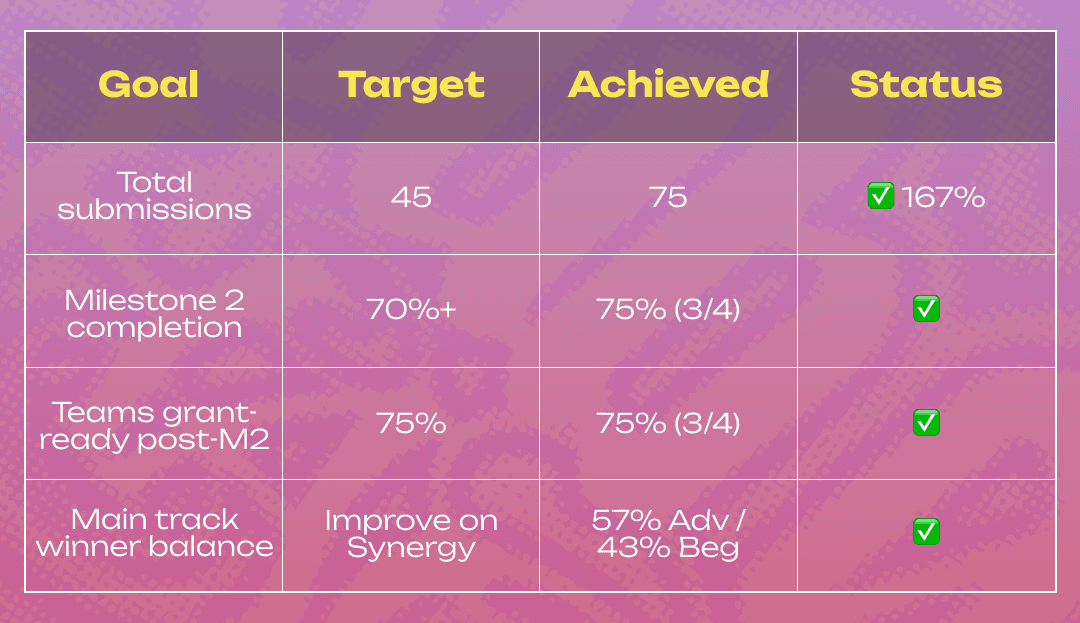
sub0 hack 2025 demonstrated continued refinement of the milestone-based hackathon model pioneered at Blockspace Synergy, while introducing key innovations around submission categorization and judging processes. The event exceeded its submission target by 67%, attracted participants from diverse blockchain backgrounds, and maintained strong Milestone 2 completion rates.

Performance Against Goals
Key Achievements
672 applications resulting in 75 unique project submissions across all tracks
~$50,000 in prizes distributed across Polkadot main track and five partner bounties
84% of submitting participants came from outside the Polkadot ecosystem
3 of 4 main track winners completed Milestone 2 with grant-ready MVPs
Key Innovations & Evidence They Worked
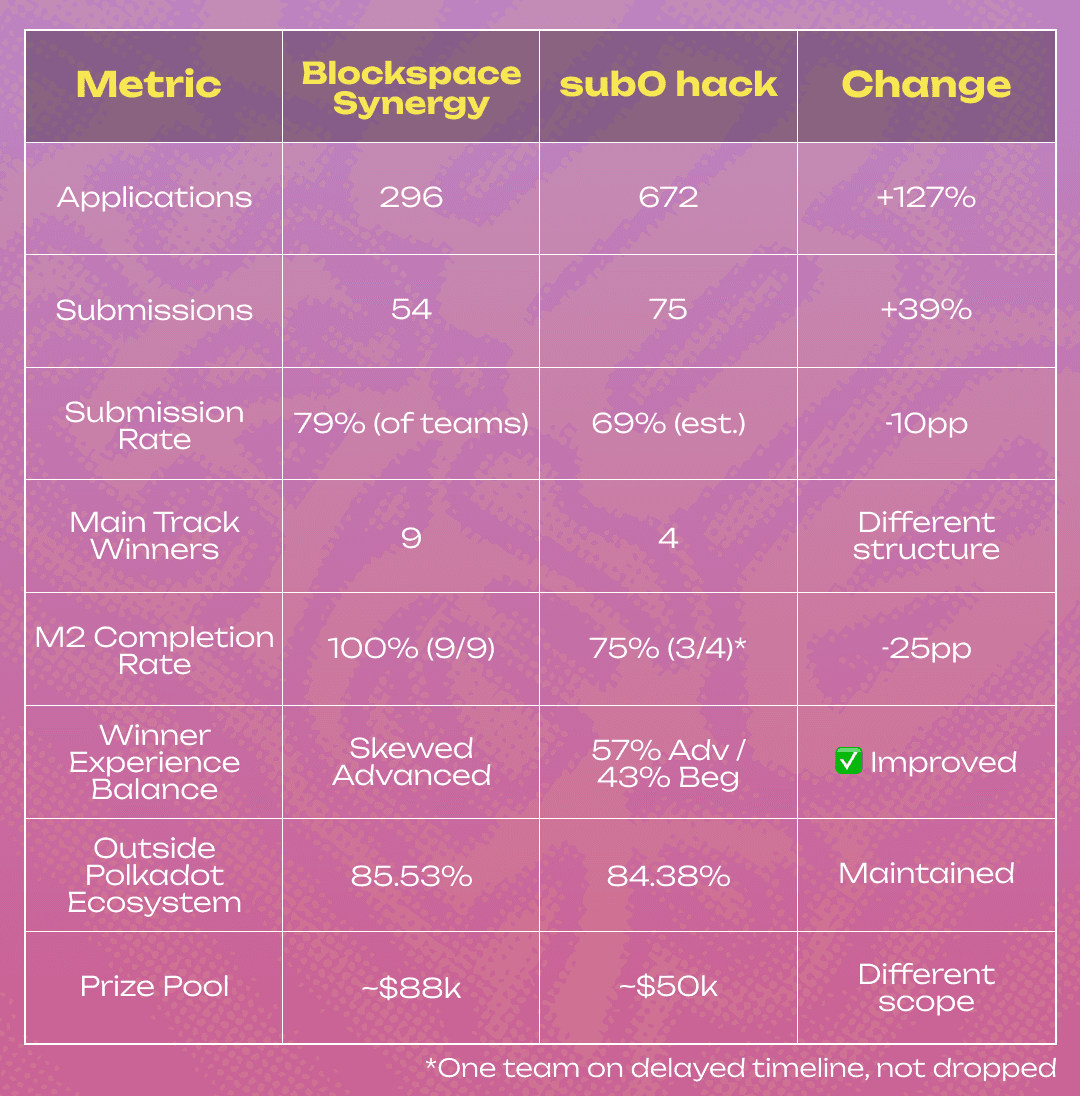
sub0 hack introduced several innovations based on learnings from Blockspace Synergy (July 2025, Berlin). This section documents each innovation, the rationale behind it, and the comparative evidence validating its effectiveness.
Comparative Overview
Innovation 1: Ship-a-thon vs Idea-ton Structure
The Problem: At Blockspace Synergy, advanced teams with more hackathon and Web3 experience dominated the main track winners, making it difficult for newer builders to compete fairly.
The Innovation: Dual submission paths allowing teams to choose their competitive category:
Ship-a-thon: For teams shipping working code deployed on testnet with functional UI
Idea-ton: For teams presenting ideas with research, architecture docs, and market validation
Evidence It Worked: The main track winner experience balance shifted from skewed-advanced at Blockspace Synergy to 57% Advanced / 43% Beginner at sub0 hack. This validates that the dual-path structure created fairer competition, allowing teams to compete on their strengths rather than just technical execution speed.
Innovation 2: Dragon Den Style Finals
The Problem: Traditional judging rounds can struggle to identify teams with genuine long-term commitment to building their projects.
The Innovation:
Top 8 teams from initial judging advanced to Dragon Den finals
4 dedicated finalist judges with diverse backgrounds (VC, Protocol, Ecosystem)
Intensive Q&A focused on long-term viability and team commitment
Evidence It Worked:
All 4 finalist winners demonstrated commitment to continue post-hackathon
3 of 4 teams completed Milestone 2 (75%), with the 4th on a delayed timeline rather than dropped
Zero teams abandoned their projects after winning
Innovation 3: Balanced Scoring Criteria (25/25/25/25)
The Problem: Technical-heavy judging criteria can disadvantage teams with strong business cases but earlier-stage technical implementations.
The Innovation: Equal weighting across four dimensions:
Product Vision: 25%
Market Research & GTM: 25%
Technical Execution: 25%
Milestone 2 Plan: 25%
Evidence It Worked:
Judges reported it was easier to identify projects with genuine continuation potential
The emphasis on M2 Plan during judging meant winners arrived with clear post-hackathon roadmaps
All winning teams had actionable M2 plans that they subsequently executed
Judge satisfaction rated 4.9/5, with 86% finding criteria clear and easy to apply
Innovation 4: Structured 6-Week Milestone 2 Program
The Problem: Traditional hackathons see <20% of projects continue development after the event ends.
The Innovation:
Split prize payment: $2k at hackathon end, $2k upon M2 completion
Dedicated mentor assignments (2-3 mentors per team)
Structured 6-week timeline with weekly check-ins
Final presentations with mentor evaluations
Evidence It Worked:
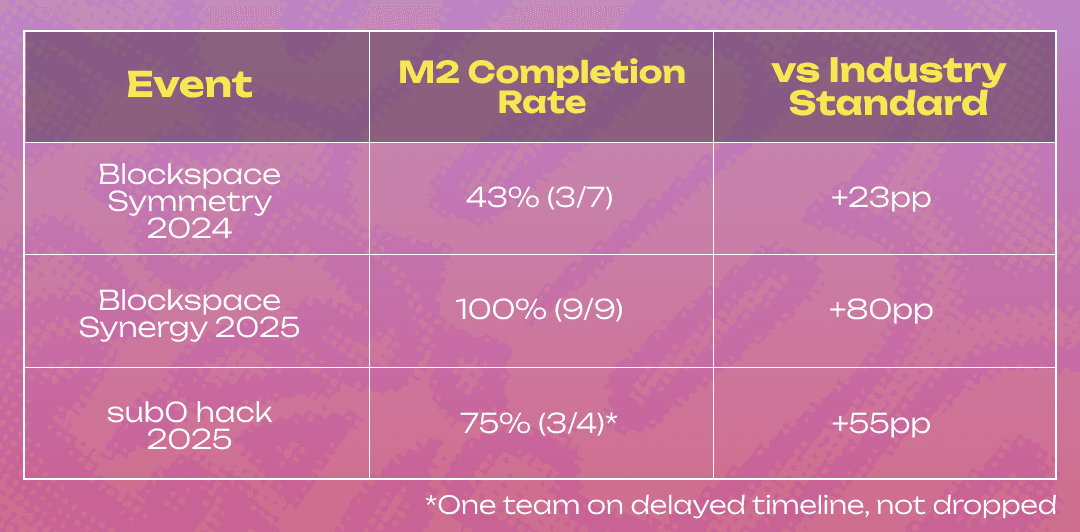
The milestone-based model consistently delivers 3-5x better continuation rates than industry standard, validating its effectiveness across multiple events and contexts.
Key Takeaways
Scale increased significantly: 127% more applications and 39% more submissions demonstrates growing interest in the milestone-based hackathon model.
Cross-ecosystem reach maintained: Both events attracted ~85% of participants from outside Polkadot, confirming the model's appeal to the broader Web3 community.
Smaller winner cohort enabled deeper support: With 4 main track winners vs 9, sub0 hack provided more intensive mentorship per team.
Comparative Analysis: Blockspace Synergy vs sub0 hackThis section compares key metrics between Blockspace Synergy (July 2025, Berlin) and sub0 hack (November 2025, Buenos Aires) to validate and refine the milestone-based model.
Key Insights
Scale increased significantly: 127% more applications and 39% more submissions demonstrates growing interest in the milestone-based hackathon model. Submission rate was slightly lower for the sub0 hack mainly because the Buenos Aires event was a much larger conference by number of overall attendees.
Ship-a-thon/Idea-ton validated: The dramatic improvement in winner experience balance (57/43 vs advanced-heavy) proves this innovation addresses the fairness problem.
Cross-ecosystem reach maintained: Both events attracted ~85% of participants from outside Polkadot, confirming the model's appeal to the broader Web3 community.
M2 model continues to outperform: Even at 75% (with one delayed, not dropped), sub0 hack dramatically exceeds industry-standard continuation rates (<20%).
Smaller winner cohort = deeper support: With 4 main track winners vs 9, sub0 hack could provide more intensive mentorship per team.
Section 1: Participant Demographics
Our strategy centered on ensuring a diverse population of attendees in terms of their backgrounds, skillsets, and experience levels.
Experience Level and Skills Distribution
Participants were scored using a combined methodology: Hackathon Points (0-3), Web3 Points (0-5), and Technical Capability (0-2), weighted as (Hackathon × 2) + (Web3 × 2) + Technical.
Scoring methodology: Combined Hackathon Points (0-3), Web3 Points (0-5), and Technical Capability (0-2), weighted as (Hackathon × 2) + (Web3 × 2) + Technical.
Developer skills dominated the participant pool, indicating opportunity to attract more non-technical founders, marketers, and product specialists in future events.
The participant pool showed a healthy distribution across experience levels: 39.9% Advanced, 30.1% Intermediate, and 30.1% Beginner.
The participant pool showed a healthy distribution across experience levels and builder skills. Insight: with a strong presence of developers, this shows more marketing efforts can be made to attract non-technical founders, marketing and product skills.
Web3 Background Distribution
Key insight: 84.38% of submitting participants came from outside the Polkadot ecosystem (24.6% Ethereum, 8.7% Solana, and others), demonstrating strong cross-ecosystem appeal and validating sub0 hack as an effective onboarding mechanism.
Participant Goals
Key insight: 55.91% of participants were focused on building real products (MVP launch + grant funding) rather than just winning prizes, aligning with sub0 hack's mission of long-term builder retention.
Team Formation
Team formation activities brought together an estimated 4 teams through organized matchmaking. Additionally, 12 online hackers submitted as part of in-person teams, demonstrating successful hybrid participation.
Section 2: Pre-to-Post Hackathon Funnel
Conversion Metrics
672 Applications↓ (45% show rate)~300 Estimated Check-ins↓ (36% submission rate)109 Participants Submitted↓75 Unique Project Submissions↓55 Polkadot Main Track Submissions↓ (15% finalist rate)8 Finalists → Dragon Den↓ (50% win rate)4 Main Track Winners↓ (75% completion rate)3 Milestone 2 Completions (1 delayed)
Track Performance
Key Observations
The largest drop-off occurs between application and check-in (55% no-show rate)
36% of checked-in participants submitted projects—room for improvement
The funnel from finalist to M2 completion (8 → 4 → 3) shows strong retention once teams reach the finals
Note: Many projects submitted to multiple tracks/bounties, so totals exceed 75 unique submissions.
Section 3: The Symbiosis Effect - Cross-Track Innovation
The theme of sub0 hack was "Symbiosis" - where different things come together and make each other stronger. This section analyzes how the event structure encouraged cross-ecosystem and cross-technology collaboration.
Bounty Stacking Patterns
Key insight: 40 of 55 main track submissions (73%) also submitted to at least one additional bounty, demonstrating strong engagement with the "symbiosis" concept.
Arkiv at a Polkadot Conference: A Symbiosis Success
One of the most notable outcomes was Arkiv's strong performance despite being a non-Polkadot technology at a Polkadot-focused event:
40 submissions to Arkiv track (vs 55 to Polkadot main track)
25 projects combined Polkadot main track + Arkiv integration
Multiple winners successfully bridged both ecosystems
This demonstrates that positioning complementary technologies together creates genuine integration rather than competition. It also demonstrates how Polkadot’s Hub is, for the first time, perceived to be compatible with a large Ethereum, smart-contract compatible project.
Multi-Bounty Winners: Symbiosis in Action
Several projects exemplified the symbiosis theme by winning across multiple tracks:
Projects That Didn't Stack Bounties
15 main track submissions focused solely on the main track without additional bounties:
Insight: Bounty stacking correlated with participation breadth but not necessarily with winning. Teams that focused deeply on one track performed comparably to those who spread across multiple bounties, suggesting both strategies are valid.
Technology Stack Combinations
The most successful multi-stack combinations included:
Polkadot + Arkiv: Data layer integration for Polkadot dApps
Polkadot + XX Network: Privacy-preserving Polkadot applications
Arkiv + XX Network: Decentralized storage with metadata privacy
Polkadot + Arkiv + XX Network: Full-stack privacy-preserving data applications
Section 4: Project Outcomes & Winners
This section documents all winning projects across tracks. For detailed analysis of partner bounty performance, see Section 9. For Milestone 2 program outcomes, see Section 6.
Polkadot Main Track Winners ($16K total)
Four winners were selected through the Dragon Den finals, each receiving $4,000 ($2k upfront + $2k on M2 completion) plus 6 weeks of dedicated mentorship.
Kleo Protocol ✅ M2 Completed
A decentralized uncollateralized lending protocol enabling trust-based loans for underserved communities, particularly targeting Latin American markets where traditional lending is often exploitative.
What they built: A decentralized uncollateralized lending protocol enabling trust-based loans for underserved communities, particularly targeting Latin American markets where traditional lending is often exploitative.
Live Demo: kleo.finance GitHub: github.com/Kleo-Protocol Demo: Video
Milestone 2 Deliverables:
Loan Event Standardization: All events now follow a schema for indexing
Repayment System: Fully functional with on-chain transfers
Protocol Revamp: New pools and vouchers architecture for better UX
Kleo SDK: Public npm package @kleo-protocol/kleo-sdk
Full beta deployed on Paseo Asset Hub with PAS tokens
Mentor Feedback (Dan Randow):
"First of all, the problem you are trying to solve is real and widespread. If you can solve it and scale that solution, this will have vast positive impact for those who lack access to loans that are not exploitative and based on violence. That in turn would have significant impact for Polkadot. The Kleo website looks great and the product demo looked good, too. The documentation you have created is impressive. Also, I see that you have considerably and thoughtfully iterated on the tokenomics, and implemented that model in the code. I think you deserve a Milestone 2 tick for that work."
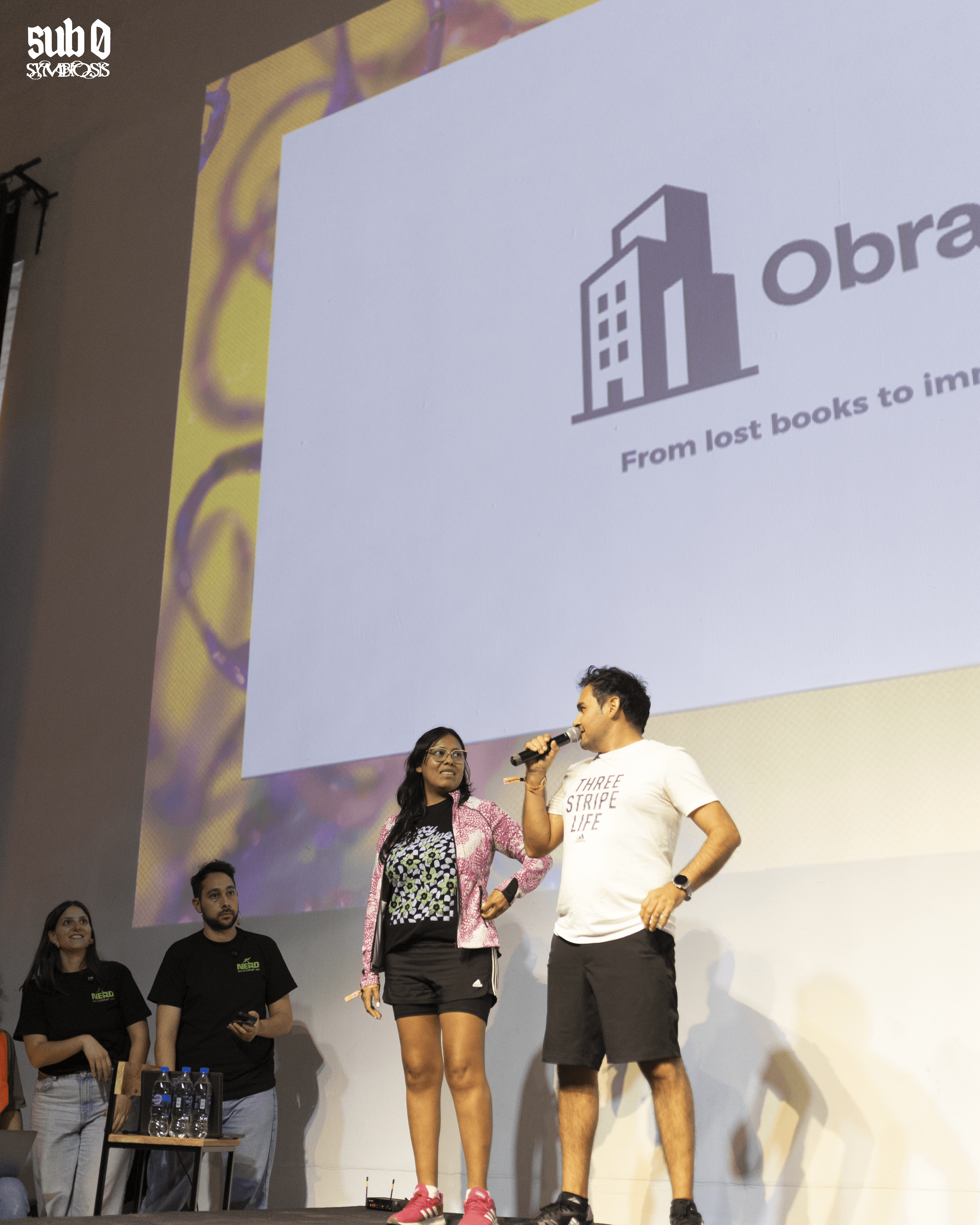
Obra Clara ✅ M2 Completed
What they built: A document verification and transparency platform using ink! smart contracts, enabling verifiable on-chain document attestation.
GitHub: github.com/obra-clara Demo: Video
OpenArkiv ✅ M2 Completed
What they built: A decentralized file sharing and attestation platform combining Arkiv's data layer with multi-hop routing architecture for resilient peer-to-peer data transmission.
Live Demo: openarkiv.vercel.app GitHub: github.com/OpenArkiv Demo: Video
Plata Mia ⏳ M2 In Progress (Delayed)
What they built: A privacy-focused payment solution integrating Polkadot with XX Network's privacy primitives and Hyperbridge's cross-chain capabilities.
Note on Delayed Timeline: Plata Mia's delay was not due to lack of commitment but to program timing. The 6-week M2 window (mid-November to early January) coincided with the holiday period, which proved unrealistic for some teams. For reporting purposes, we count Plata Mia as "in progress" rather than "completed" to maintain consistent control variables. However, the team remains on track for February 16 completion.
Arkiv Track Winners ($10K total)
XX Network Bounty Winners ($9K total)
Mixnet Use Cases ($6K)
Kusama Bounty Winners ($5K total)
Hyperbridge Bounty Winners ($5K total, $4.5 awarded)
Marketing Bounty Winners ($5K total)
The Marketing Bounty ran two challenges designed to boost Polkadot awareness and help hackathon projects with go-to-market strategies.
Challenge 1: Creative Marketing Strategies ($2,500)
Focus: Campaigns to boost Polkadot awareness and adoption among developers, creators, and everyday users.
Note: Three-way tie for top submissions; prizes split accordingly
Honorable Mentions (2 votes):
DOT Manifesto — "Well-done presentation, high-level concept"
Week Zero — Mixed feedback on budget feasibility
Challenge 2: Hacker Launch Campaigns ($2,500)
Focus: Marketing campaigns designed to launch hackathon projects to their target audiences.
Also received 2 votes: Public Sale Launcher, Connected by the Dots
Winner Experience Distribution
A key goal of sub0 hack was creating fairer competition across experience levels through the Ship-a-thon/Idea-ton structure.
Polkadot Main Track Winners:
Advanced: 57.1%
Beginner: 42.9%
This balanced distribution validates the dual-path structure. However, across all bounties (not just main track), advanced teams still dominated at 76%, suggesting the innovation primarily impacted main track judging. Below is the data for experience levels across winning tracks.
Experience Distribution of All Winners
Polkadot Main Track Winner Distribution
The main track results show a dramatically more balanced distribution than Blockspace Synergy. This meant that:
Ship-a-thon teams competed on technical execution and deployment
Idea-ton teams competed on vision, research, and market validation
Judges could evaluate each submission type against appropriate criteria
Across all bounties (not just main track), advanced teams still dominated (76%). This suggests the innovation primarily impacted main track judging. Consider extending Ship-a-thon/Idea-ton structure to partner bounties.
For detailed analysis of bounty performance and recommendations, see Section 9.
Section 5: Milestone 2 Program Deep Dive
The 6-week Milestone 2 mentorship incubator is a cornerstone of the sub0 hack model, transforming hackathon projects into grant-ready products.
Program Structure
Prize Structure: $4k per team
$2k paid at hackathon completion
$2k paid upon Milestone 2 approval
Mentor Assignment: 2-3 dedicated mentors per team
Program Timeline
Post-Program: Ongoing support with grant applications, investor intros, alumni network
Results Summary
Team-by-Team Outcomes
Kleo Protocol ✅ Approved January 13, 2026
Mentors: Alex Bean, Dan Randow
M2 Deliverables:
Loan Event Standardization: All events now follow a schema for indexing
Repayment System: Fully functional with on-chain transfers
Protocol Revamp: New pools and vouchers architecture for better UX
Kleo SDK: Public npm package @kleo-protocol/kleo-sdk
Full beta deployed on Paseo Asset Hub with PAS tokens
Mentor Feedback (Dan Randow):
"First of all, the problem you are trying to solve is real and widespread. If you can solve it and scale that solution, this will have vast positive impact for those who lack access to loans that are not exploitative and based on violence. That in turn would have significant impact for Polkadot. The Kleo website looks great and the product demo looked good, too. The documentation you have created is impressive. Also, I see that you have considerably and thoughtfully iterated on the tokenomics, and implemented that model in the code. I think you deserve a Milestone 2 tick for that work."
Recommendations for grant readiness:
Evidence that tokenomics is workable with good and malicious actors
Lean Canvas outlining business model
Latam pilot mentioned in roadmap
Obra Clara ✅ Approved January 16, 2026
Mentors: Alberto Penayo, Alex Bean, Nasihudeen Jimoh
M2 Deliverables:
Smart contract repository for document verification
Comprehensive documentation
Milestone 2 Completion Summary
Mentor Feedback (Nasihudeen Jimoh):
"First of all I'm really impressed with what you guys pulled off, especially considering there was no prior smart contract experience. That's genuinely commendable, and I'm really happy to be part of the journey with Obra Clara. Overall progress is solid and what you've achieved so far is impressive. You're definitely on the right track."
Areas for improvement:
Clearer demonstration of on-chain data storage
Transaction signing visibility
Block explorer verification
Payment Status: Issued January 16, finalized January 22, 2026
OpenArkiv ✅ Approved (Under Final Review)
Mentors: Richard Carback, Matthias Zimmermann
M2 Deliverables:
Refactored codebase for scalability and continued development
Multi-hop architecture capable of routing payloads across n devices
Validated multi-hop flows using BitChat architecture with test cases
Open Attestation schema on Arkiv with location coordinates
Refactored device key generation and signature flows for secure multi-device usage
Media support with base64 encoding strategies
Encrypted payload encryption/decryption flows (partial implementation)
New landing site with sideloading instructions and release file for app installation
Plata Mia ⏳ In Progress (Delayed)
Mentors: Richard Carback, Juan Girini, Femi Olah
Scheduled completion: February 16, 2026
M2 Work Underway:
Wallet UI integration (Talisman/Subwallet SDK engineering)
Hyperbridge advanced storage query patterns & message passing
XX Network privacy primitives validation
XCM pay-with-stealth flows
Wallet notification bridge architecture
Section 6: Ecosystem & Support Infrastructure
sub0 hack was made possible through an extensive network of ecosystem partners who contributed mentorship, technical expertise, judging support, and bounty sponsorship.
Partner Contributions Overview
Mentorship Partners
The following organizations provided mentors during the hackathon weekend:
Notable contributions:
Parity Technologies: Multiple mentors across technical, UI/UX, and business tracks (Charles, Alberto, Shawn, Reinhard)
R0gue: ink! and Substrate expertise (Alex Bean, Daan)
Arkiv: Dedicated 4-person mentor team (Marcos, Matthias, Dragan, Ramses)
Hyperbridge/Polytope Labs: Cross-chain technical support (Femi Olah and David Salami)
Regional Partners: Enabled Latin American community engagement (Polkadot Africa, Web3Dev, DESAFIA, ChainPal)
Mentor Roster by Expertise
Bounty Sponsors
In additional to Polkadot’s $16k main track prize pool, five partners sponsored dedicated bounties, contributing an additional $34K.
Judging Panel for Polkadot
Main Track Round (9 judges)
Finalist Round - Dragon Den (4 judges)
Ben McMahon – COO at Hydration (Intergalactic), Ben eads operations and strategy across the protocol, with a focus on DeFi design and ecosystem growth. He’s a regular speaker at industry events on decentralized finance and protocol development.
Marni Rabasso - Co-founder at Two Pebbles Ventures with over 30 years of experience in software and blockchain. She previously served as VP of Natural Resources at Dassault Systèmes and currently chairs the board at Novamera Inc., bringing expertise in digital transformation for industry.
Marco Moshi - Co-founder at Magenta Labs and former Head of Community at Matter Labs for ZKsync. Previously Director of Growth at Polygon Labs, where he led DAO business development and launched Polygon Village, an initiative combining grants, accelerator programs, and community mentorship.
Laura Gonzalez - CEO of Zeolit and Architect at Founder School, part of Protocol Labs' innovation network supporting pre-seed founders. She previously served as CBO Strategic Growth at Cloud9 and as Architect Advisor & Mentor at Makers Fellowship in LatAm. Laura also co-founded Leva Carnato, a women's fashion brand focused on comfort and self-expression.
Panel Design: Balanced across tech, product, marketing, and ecosystem stakeholders to ensure comprehensive evaluation aligned with 25/25/25/25 scoring criteria. Finalist judges were tasked to identify teams who are most likely to successfully complete their projects’ milestone 2 and launch their MVPs.
Event Programming
Barcamp Session: UX for Polkadot dApps
Open discussion to address common UX challenges in the ecosystem
Informed by pre-event data showing strong UI/UX interest (29.5% of registrations)
Workshops:
Polkadot Hacking with POP CLII: Introduction on how to easily get started with developing on Polkadot
Vibe Coding Tips: how to set-up your vibe coding environment for prototyping fast with Polkadot
Open Zepplin Tooling & Tips: getting started with Open Zepplin on Polkadot
Bring Data into Your Dapps with Arkiv: how to get started with Arkiv
Office hours:
Daily office hours with rotating mentor shifts
Pitching Clinic: Extendd sessions with experts (Alice from SPACE ID, Shawn from Parity, Matute from Piggy Wallet, Tom from NERDCONF) to help teams prepare their presentations. This was added based on judge feedback from previous events indicating teams often struggled with pitch structure and delivery.
Section 7: Partner & Sponsor Analysis
This section analyzes the performance of each bounty track and provides recommendations for future events. For complete winner listings, see Section 4.
Arkiv Track - Success Story
Arkiv ran a full main track ($10K) alongside the Polkadot main track and achieved strong results.
Performance Summary
Why Arkiv succeeded:
Clear SDK documentation
Dedicated Arkiv mentors (Marcos, Matthias, Dragan, Ramses)
Natural complement to Polkadot projects built with EVM compatible smart contracts (data layer)
Micro bounty structure encouraged experimentation
The high submission count and strong overlap with main track winners demonstrates successful "symbiosis" — Arkiv's data layer complemented Polkadot projects naturally, rather than competing for attention. This also shows how Polkadot's Hub is, for the first time, perceived to be compatible with a large Ethereum-compatible, smart-contract project.
XX Network - Strong Engagement
XX Network ran privacy-focused bounties totaling $9K.
Performance Summary
What worked:
Privacy primitives complemented other tech stacks
Clear use case categories (Mixnet + Guerrilla Marketing)
Teams found creative ways to combine XX with Polkadot/Arkiv
The submission count was strong for a project with lower brand recognition, and use cases exemplified the symbiosis theme by combining XX's privacy tech with Polkadot and Arkiv stacks.
Hyperbridge - Technical Barriers
Hyperbridge offered $5K for cross-chain storage query innovation.
Performance Summary
Root Cause Analysis:
Participants lacked examples to draw from
Documentation didn't sufficiently bridge the complexity gap
Mentorship alone couldn't compensate for SDK learning curve
Winners were only awarded their prize after successful implementation with post-hackathon mentorship support
Recommendations for Future:
Pre-hackathon workshops on Hyperbridge SDK
Starter templates and boilerplate code
More code examples in documentation
Consider "Hyperbridge 101" track for simpler integrations
Kusama - Category Clarity Needed
Kusama offered $5K for Arts & Social Experiments.
Performance Summary
Root Cause Analysis:
"Art and Social Experiments" is inherently abstract
Participants unsure what qualified
High submission count but low alignment suggests confusion
Recommendations for Future:
Provide 3-5 concrete example projects
Create clearer evaluation rubric
Consider sub-categories with specific criteria
Marketing Bounty - Quality Gap
The Marketing Bounty ran two challenges totaling $5K.
Cross-Track Participation Problem:
13 of 20 Challenge 2 submissions (65%) came from teams who also submitted to technical tracks. However, most cross-track submissions received zero votes:
Even OpenArkiv, a Polkadot Main Track winner, received zero votes for its marketing submission.
Root Cause Analysis:
Challenge 2 requirements were unclear — high volume but 60% received zero votes
Technical teams treated marketing as a checkbox rather than genuine effort
No collaboration requirement between technical and marketing skills
Missing implementation details — judges noted submissions lacked budget estimates, distribution channels, production timelines
Judge Feedback Pattern:
"The idea is fun and really nice but it's missing a lot of the implementation elements: where do we post this, budget estimate, production costs, distribution, etc."
What Worked:
Challenge 1 (standalone marketing strategies) produced quality submissions
Top submissions had "achievable goals" and clear execution plans
Recommendations for Future:
Require explicit marketing-technical team collaboration for Challenge 2
Define clear deliverables: budget, channels, timeline, success metrics
Recruit marketing-focused participants separately, then facilitate team pairing
Ensure language-appropriate mentors (Spanish-speaking gap noted)
Consider "Technical + Marketing" joint prize requiring both skillsets
Section 8: Feedback, Lessons Learned & Recommendations
This section presents feedback collected from mentors, judges, and participants, synthesizes key lessons, and outlines recommendations for future events.
Feedback Collection Overview
Mentor Feedback
Overall Rating: 4.4 / 5 Would Mentor Again: 100% Yes
What Worked Well
Mentors consistently praised the overall organization and the quality of interactions with teams:
"WebZero have done a great job."
"The final presentation of the winners always brings everyone together. Having everything in one building was a huge win: hacking spaces, a rooftop for relaxing with beers, expert talks… overall a great experience."
"Going deep with the Kleo team at the start was cool. They really did not know what problem to solve. We pushed it hard and figured it out. They sought me out later to thank me and appreciate how valuable that was. Melted my heart."
The most impactful mentoring moments were often spontaneous rather than during scheduled office hours:
"A brief session where they really got which direction they could go. They sought me out later to appreciate that. I definitely did not expect those moments!"
Areas for Improvement:
Some mentors reported feeling lost about which teams to help and where to go across the hacker space.
Standout Teams Mentioned: Carbon Smart Meter, Kleo Protocol, The People's Vote
Judge Feedback
Overall Rating: 4.9 / 5 Would Judge Again: 100% Yes (86% definite, 14% maybe)
What Worked Well
Judges praised the judging infrastructure and collaboration:
"Format, judging dimensions, other judges were great."
"The spreadsheet was amazing! Super easy to work with and made the whole process very snappy."
"Judging criteria was straightforward. The judging spreadsheet made it very simple to quickly have a score for the projects."
"Judges level and quality was optimal, the organization was great, everyone was super supportive and collaborative. It was also fast to identify the winners."
Project Quality Assessment
Judges noted variance in project quality:
"The quality of the projects was not super-high, the idea track was a bit too far from becoming real products."
"One project was very likely to have worked on the submitted component for much longer than during the hackathon."
Areas for Improvement
Participant Feedback
Overall Rating: 4.4 / 5 Would Participate Again: 92% Yes
What Worked Well
Participants highlighted the hackathon itself as the standout:
"The atmosphere that was created out of the pure chaos."
"The opportunity to put our skills to the test in the hackathon was the highlight."
"I really liked that the side events happened in house."
Mentor Interactions:
83% of respondents interacted with mentors
Mentor helpfulness rating: 4.7 / 5
92% found mentor availability sufficient
Standout Mentors Named: Dan Randow (Hack Humanity), Alice (SPACE.ID), Sacha (WebZero)
"Shout out to Dan Rainbow - absolutely amazing pre-submission feedback on our overall story and presentation, with a couple words exchanged a ton of value, in combination with genuine interest in our creation." - Main Track Participant
Judging Format Feedback
"It would be great if the judges could provide feedback on the final evaluations. The criteria were not entirely clear, and knowing the specific points where our project needs improvement would be invaluable."
Best Parts of the Event (Participant Quotes)
"The hackathon"
"The pitches"
"The atmosphere that was created out of the pure chaos"
"Venue and swag"
"The experience of the team that was organizing the event"
"The ball pit"
Summary of Feedback Scores
What Worked Well — Key Takeaways
Based on the feedback above, these elements should be preserved in future events:
Areas Needing Attention
🔴 High Priority
🟠 Medium Priority
Bounty-Specific Ideas for Improvements
Hyperbridge:
Pre-hackathon workshops on Hyperbridge SDK
Starter templates and boilerplate code
More code examples in documentation
Consider "Hyperbridge 101" track for simpler integrations
Kusama:
Provide 3-5 concrete example projects for "Art and Social Experiments"
Create clearer evaluation rubric
Consider sub-categories with specific criteria
Marketing Bounty:
Require explicit marketing-technical team collaboration for Challenge 2
Define clear deliverables: budget, channels, timeline, success metrics
Recruit marketing-focused participants separately, then facilitate team pairing
Ensure language-appropriate mentors (Spanish-speaking gap noted)
Consider "Technical + Marketing" joint prize requiring both skillsets
Operational Improvements
Target Metrics for Next Event
Conclusion
sub0 hack 2025 validated the milestone-based hackathon model while revealing opportunities for operational improvement for future hackahtons we organize at WebZero.
The innovations introduced—Ship-a-thon/Idea-ton dual tracks, Dragon Den finals, balanced 25/25/25/25 scoring, and the 6-week M2 program—each delivered measurable results. Winner experience balance improved dramatically. All finalist teams remained committed post-hackathon. Three of four main track winners completed Milestone 2 with grant-ready MVPs; the fourth is on a delayed timeline rather than abandoned.
The 75% M2 completion rate, while below Blockspace Synergy's 100%, still represents a 3-4x improvement over the industry standard of less than 20%. Kleo Protocol, Obra Clara, and OpenArkiv now have working products, mentor relationships, and clear paths to grants. These aren't hackathon prototypes abandoned after a weekend—they're real projects with real momentum.
Feedback validates the approach: 92% of participants would return, 100% of mentors and judges would serve again. The symbiosis theme delivered genuine cross-ecosystem collaboration, with 73% of main track submissions also entering partner bounties and 84% of participants coming from outside Polkadot.
Areas for improvement are clear: pitch preparation, mentor-team matching, show rates, and bounty-specific adjustments for Hyperbridge, Kusama, and the Marketing track.
What We've Learned About Builders
One insight stands out: builders care more about community and support than the specific technologies they're building with. The right structure matters more than the stack. This is why carefully selecting sponsors who complement each other is important, it gives builders options to combine technologies in ways that haven't been tried before, and creates opportunities for continued collaboration between teams and sponsors after the hackathon ends.
This means we must invest in builders. We must support them and guide them for as long as they are eager to build. At WebZero, our role is to remain agnostic and source the best support we believe in, regardless of who the sponsor is. Over the next 12 months, we plan to be a resource for builders from our M2 cohorts, connecting them with grants, facilitating user beta testing, and providing ongoing mentorship support. This is what we believe teams need. Hackathons are the launch pad. Guiding and supporting teams between events is the greater task.
Looking Ahead
This is the third time WebZero has run this model, Blockspace Symmetry 2024, Blockspace Synergy 2025, and now sub0 hack. Each iteration has brought incremental improvements and consistent results across different audiences, scales, and contexts. The approach works. We're now exploring how to formalize this model for ecosystems beyond Polkadot.
Specific plans for the coming year:
Ship-a-thon as a continuation track: We will continue offering Ship-a-thon as an explicit invitation for builders to return to future hackathons and continue developing existing submissions. Projects don't need to start from zero each time.
Expanded mentorship partnerships: We need more partnerships with product experts and business strategy specialists to help teams navigate their next steps beyond technical development.
Open invitation to funds and grants programs: We invite any fund or grants program interested in partnering with us on our mission to provide continued milestone-based support and funding for teams building real products for web3. Reach out.
Hackathons have long been criticized as unsustainable, weekend sprints that produce abandoned repos and forgotten pitch decks. sub0 hack shows that with the right structure, this doesn't have to be the case. Three teams are now shipping products that started as 48-hour prototypes. That's the point. That's what we're building toward. We believe that with this hackathon model as a cornerstone for bringing new developers into web3, our role is to build the rails to support builders to launch products in web3.
Acknowledgments
sub0 hack's success was built on the generous contributions of time, expertise, and resources from across the Polkadot ecosystem and beyond.
Event Organization
NERDCONF for collaborating on event organization and providing pitching clinic support
Mentorship & Technical Support
Alberto, Charles and Shawn from Parity Technologies for deep technical mentorship across multiple tracks
Daan, Alejandro and Alex from R0gue for ink! expertise and continued M2 support
Marcos, Matthias, Dragan and Ramses from Arkiv for running a full parallel main track with a dedicated integration support for teams working on multiple bounties
Hyperbridge/Polytope Labs for cross-chain technical guidance
XX Network for privacy primitives expertise
Regional partners (Polkadot Africa, Web3Dev, DESAFIA, ChainPal, Space4Build) for enabling Latin American community participation
Judging
All 13 judges across the Polkadot main track who stayed late to review projects thoroughly and helped identify teams with genuine potential for long-term success
Bounty Sponsors
Arkiv, XX Network, Kusama, Hyperbridge, and Web3 Marketing Hackathon for contributing $34K in additional prize pools
Michael Naftaliev from Scytale for facilitating the marketing sponsorship and serving as both mentor and judge
Milestone 2 Program
All M2 mentors who committed 6+ weeks of continued support beyond the hackathon weekend, turning weekend prototypes into grant-ready products
Henriette from Braille for dedicating time and care in supporting teams post-hackathon
Appendix
Appendix A: Data Sources
All submissions data: Master sheet table
Pre-event data: Metabase dashboard tracking 672 applications
During-event data: Real-time participation tracking
Post-event data: Submission analysis and winner tracking
M2 tracking: Internal program management
Feedback: feedback forms for participants, mentors and judges
Appendix B: Links & Resources
Main Track Winner Deployments:
Kleo Protocol: https://dapp.kleo.finance/
OpenArkiv: https://openarkiv.vercel.app
Main Track Winner Repositories:
Kleo Protocol: github.com/Kleo-Protocol
Obra Clara: github.com/obra-clara
OpenArkiv: github.com/OpenArkiv
Plata Mia: github.com/Plata-Mia
Demo Videos:
Kleo Protocol: youtu.be/i9du6iR0uiI
Obra Clara: youtu.be/_4Z4MabWh8E
OpenArkiv: youtu.be/zQvZUBh5aco
Report prepared by Sacha Lansky | January 2026